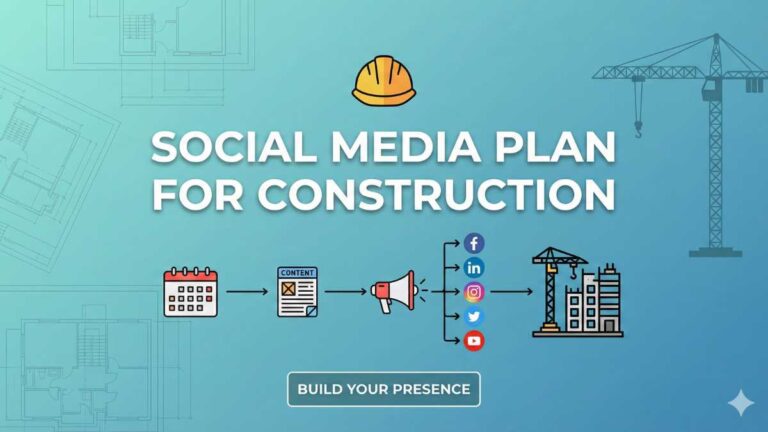
Social media is no longer optional for construction companies.
Today, it plays a critical role in how builders, roofers, and home improvement businesses are discovered, evaluated, and trusted — long before the first phone call happens.
Table of Contents
ToggleBut posting randomly or copying what other industries do is not a strategy. For construction businesses, social media must be structured, intentional, and aligned with real buying behavior.
This guide explains how to create a social media plan for a construction business, step by step, with a strong focus on authority, trust, local visibility, and lead generation.

Why social media matters for construction companies?
If what they see feels inconsistent, outdated, or improvised, trust drops immediately.
Step 1: define clear objectives (before posting anything)
Step 2: understand your construction audience

Step 3: choose the right platforms
You don’t need to be everywhere. You need to be effective where it matters.
Instagram
Best for:
• Visual proof of work
• Before-and-after projects
• Reels and short videos
• Brand perception
Instagram is often the first platform clients check.
LinkedIn
Best for:
• Authority positioning
• Commercial and B2B construction
• Partnerships
• Leadership presence
LinkedIn builds business credibility, especially for larger projects.
Useful for:
• Local visibility
• Community groups
• Retargeting ads
YouTube (Optional but Powerful)
Best for:
• Long-form project walkthroughs
• Educational authority
• SEO support through video search
Step 4: build content pillars for construction
A strong social media plan is built on content pillars, not random ideas.
Recommended pillars for construction businesses:
1. Authority & trust
• Professional statements
• Industry positioning
• Experience-based insights
• Market commentary
2. Proof of Work
• Completed projects
• Before-and-after visuals
• Progress videos
• Client testimonials
3. Education (Selective)
• Explaining services
• Answering common questions
• Clarifying misconceptions
Education should be strategic, not overwhelming.
4. Differentiation
• What makes your company different
• Process clarity
• Quality standards
• Professional structure
5. Time & market pressure
• Why waiting costs money
• Market changes
• Seasonal considerations
Step 5: create a posting structure (consistency beats frequency)
Posting daily without strategy creates noise.
Posting consistently with structure creates trust.
A weekly structure example:
• Monday: Authority / Positioning
• Tuesday: Pain Point / Problem Awareness
• Wednesday: Proof / Project
• Thursday: Differentiation / Process
• Friday: Market Insight / Time Pressure
• Saturday: Video (Reel or Short Clip)
• Sunday: Soft Reminder / Brand Reinforcement
This structure keeps your brand mentally present without exhausting your audience.

Step 6: optimize captions for SEO and GEO
Social media captions now contribute to discoverability.
Best practices:
• Use service keywords naturally (roofing, remodeling, construction)
• Mention locations when relevant
• Avoid generic captions
• Write clearly and professionally
Search engines increasingly read social platforms as brand validation signals.
Step 7: use video strategically
Video is the highest-performing format for construction.
Effective video ideas:
• Project walkthroughs
• Progress updates
• Short authority statements
• Client testimonials
• Before-and-after transformations
Video builds trust faster than images alone.
Step 8: integrate social media with your website and SEO
Social media should not exist in isolation.
Strong integration includes:
• Linking posts to service pages
• Driving traffic to blog articles
• Supporting Google Business Profile activity
• Retargeting website visitors
Social media strengthens SEO by reinforcing brand legitimacy and engagement signals.
Step 9: measure what actually matters
Forget vanity metrics.
Track:
• Profile visits
• Website clicks
• Direct messages
• Lead quality
• Conversion influence
Social media success for construction is measured by trust and deal acceleration, not likes.
Step 10: avoid common mistakes
Common errors construction companies make:
• Posting without a plan
• Copying other industries
• Over-educating instead of positioning
• Ignoring branding consistency
• Treating social media as a side task
Your social media presence reflects how you run your business.
Why most construction social media plans fail
They fail because:
• They are improvised
• They lack industry focus
• They are disconnected from sales
• They prioritize activity over strategy
Social media must feel intentional, not accidental.
How Caldas Marketing builds social media plans for Construction Companies
At Caldas Marketing, we don’t create random content calendars.
We build complete social media operations for construction companies, aligned with:
• Branding
• SEO and GEO strategy
• Website performance
• Lead generation
• Sales positioning
Our plans are designed to:
• Build authority
• Filter low-quality leads
• Reinforce trust
• Support long-term growth
One strategy.
One message.
One operation.
A social media plan for a construction business is not about posting more.
It’s about showing up correctly.
When done right, social media:
• Pre-qualifies clients
• Strengthens your brand
• Supports higher pricing
• Makes selling easier
FAQ — How to create a social media plan for a construction business
1 – What is the best social media platform for construction companies?
Instagram and LinkedIn are the most effective platforms for construction companies. Instagram is ideal for visual proof such as projects, progress, and before-and-after results, which build trust quickly. LinkedIn strengthens business credibility, especially for commercial projects, partnerships, and decision-makers. Together, they support both trust and authority.
2 – How often should a construction business post on social media?
Posting 3 to 5 times per week with a clear structure is more effective than posting daily without strategy. Consistency and intention matter more than volume. Each post should serve a purpose—authority, proof, or differentiation—rather than filling space.
3 – Does social media help with local SEO and GEO visibility?
Yes. Social media supports local SEO and GEO signals by reinforcing brand legitimacy, location relevance, and trust. When aligned with your website and Google Business Profile, it strengthens your overall online presence and local discoverability.
4 – Should construction companies use Reels and short-form videos?
Absolutely. Short-form video is one of the strongest trust-building tools in construction marketing. Reels allow potential clients to quickly see quality, professionalism, and real project execution, making video content consistently outperform static posts.
5 – Can social media generate leads for construction companies?
Yes, when integrated with a broader marketing strategy. Social media works best as a trust and positioning channel that supports conversions through your website, SEO, and Google presence. It shortens the sales cycle by pre-qualifying clients.
6 – Is social media more important than having a website?
No. Your website remains the primary conversion asset. Social media supports the website by reinforcing credibility and authority. If the website is weak, social media exposure will only amplify that weakness.
7 – What type of content works best for construction businesses?
Content focused on authority, proof, and differentiation performs best. This includes completed projects, before-and-after visuals, testimonials, and clear service explanations. Professional and intentional content builds trust faster than casual or trendy posts.
8 – Should construction companies show pricing on social media?
In most cases, no. Construction pricing varies widely, and public pricing often attracts low-quality leads. Social media should communicate value, quality, and professionalism, encouraging qualified prospects to request consultations instead.
9 – How does social media support higher pricing in construction?
A strong social media presence reinforces professionalism and stability. When clients perceive a brand as established and trustworthy, price becomes less of a deciding factor. This supports stronger negotiations and higher-value projects.
10 – What are the most common social media mistakes construction companies make?
Common mistakes include posting without strategy, copying content from other industries, ignoring brand consistency, and treating social media as an afterthought. These errors weaken trust and reduce perceived professionalism.
11 – Do small construction companies need a social media plan?
Yes. A structured social media plan helps smaller companies compete with larger firms by projecting professionalism and authority. Strategy allows smaller builders to look established and credible in competitive markets.
12 – How long does it take to see results from social media marketing?
Social media is a long-term trust-building channel. Most construction companies begin seeing meaningful impact within 60 to 90 days, usually through better lead quality and faster decision-making rather than immediate volume increases.
13 – Should construction companies hire an agency to manage social media?
Yes—if the agency understands the construction industry. Construction-focused social media requires positioning, SEO alignment, and brand consistency. Generalist agencies often produce content that fails to build real trust or results.